Academic Art
Where technical mastery meets mythological grandeur, Academic Art embodies the pinnacle of classical training. These works breathe life into historical narratives with polished precision, celebrating the human form through rigorous composition and idealized beauty.
-
 (1879)-full.webp "La petite écolière (The Little Schoolgirl) (1879) by William Bouguereau")
La petite écolière (The Little Schoolgirl) (1879)
A young girl clutches her books, her gaze steady yet distant. The folds of her dress catch the light, soft against the muted background. There’s something unspoken in her posture—not quite reluctance, not quite resolve—just the quiet weight of a child stepping into an unseen world.
-

A Beauty In Eastern Costume
A woman draped in rich Eastern fabrics gazes past the viewer, her delicate features framed by intricate jewelry. The folds of her gown catch the light, hinting at movement frozen in time. There’s a quiet intensity in her distant expression, as if lost in thought just beyond the canvas.
-
-full.webp "Portrait de Madame Charles Chaplin (1863) by Charles Chaplin")
Portrait de Madame Charles Chaplin (1863)
A young woman gazes past the viewer, her delicate features framed by soft curls. The lace at her collar catches the light, contrasting with the rich darkness of her dress. There’s a quiet intensity in her expression—neither melancholy nor joy, but something poised between the two.
-
-full.webp "Nu à la psyche (1910) by Henri Gervex")
Nu à la psyche (1910)
A woman stands before a mirror, her body bathed in soft light. The reflection blurs the line between reality and illusion, her gaze meeting ours through the glass. The curve of her back, the fall of fabric—each detail pulls us deeper into this intimate moment suspended between seeing and being seen.
-

The Rose
A woman holds a single rose, its petals soft against her fingertips. The light catches the delicate folds of her dress, framing the quiet intensity in her gaze. There’s something unspoken in the way she cradles the flower—a moment suspended between offering and keeping.
-
-full.webp "A Greek Woman (1869) by Lawrence Alma-Tadema")
A Greek Woman (1869)
A Greek woman stands in profile, draped in flowing white linen. Her fingers lightly touch a marble column as sunlight catches the folds of her garment. The air feels still, heavy with the warmth of an afternoon long past. Every detail whispers of quiet dignity and unspoken stories.
-

A Classical Beauty
A young woman gazes past the viewer, her delicate features framed by cascading curls. The soft glow of her ivory skin contrasts with the rich, dark background, lending an air of quiet elegance. Her poised expression hints at unspoken thoughts, drawing the eye to linger.
-
-full.webp "Frage an die Karten (1889) by Édouard Bisson")
Frage an die Karten (1889)
A woman leans over scattered cards, her fingers hovering above their cryptic symbols. The dim light catches her intent expression—half doubt, half longing—as if the answer lies just beyond the next turn. The air hums with possibility.
-
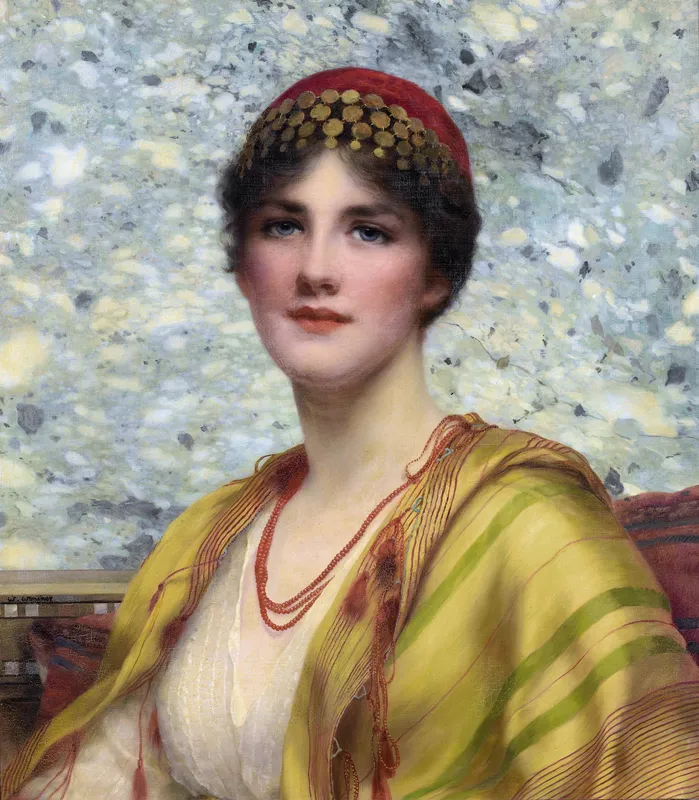
Leonora
A woman gazes from the canvas, her Victorian dress rich with detail, the soft light catching the folds of fabric. There’s a quiet intensity in her expression—neither smiling nor solemn, but something in between, as if she’s just paused mid-thought. The portrait lingers, unreadable.