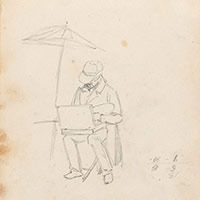
Giuseppe Zannoni (1849–1903), Italian, Giuseppe Zannoni, an Italian painter born in Verona in 1849, emerged as a notable figure in the art scene of his time. His artistic journey began at the Accademia Cignaroli in Verona, where his talent was recognized through awards in local exhibitions from 1865 to 1871. Seeking further development, Zannoni moved to Milan with his cousin, the sculptor Ugo Zannoni, and enrolled at the Accademia di Brera. There, he studied under Giuseppe Bertini, honing his skills and expanding his artistic horizons. Zannoni's work, characterized by its diversity, ranged from historical themes, as seen in 'Marco Antonio rivela al popolo romano il mantello insanguinato di Cesare' exhibited in Naples in 1877, to genre paintings like 'Arrivo degli sposi' and 'Cacciatore e volpe' showcased in Milan in 1891. His contributions to religious art were significant, with frescoes in various churches, particularly in Verona, including the church dei Filippini. In 1890, he created 'Sacro Cuore e Santi' and an 'Assunzione di Maria' for the church of Santa Maria alla Porta in Milan. Zannoni's career was tragically cut short in 1903 when he died from a fall off scaffolding in Monteforte d'Alpone, just days after beginning work on the fresco 'Trinità' in the local parish church. His legacy is preserved through his vibrant depictions of life, religion, and history, marking him as a distinguished artist of his era.